

Are you going to start writing content for your IT company? Then of course you want this text to be findable within Google search results. There are hundreds of SEO factors that determine your success, which can be divided into off-page SEO (factors outside your website) and on-page SEO (factors that you can adjust yourself within your website). With this blog we focus on the on-page factors and in particular the written content itself.
Main text and meta text
When talking about writing SEO-optimized text, you can distinguish between two variables: the main text and the meta text. The main text can be found in the body (the actual content) of your page and the meta text in the head (code with important information about your page). We divide the tips into main text tips and meta text tips.
Tips for the main text
The first step in writing your content is to determine the main keyword. To do this do a keyword research to see if there is search volume on it. Tools you can use are the keyword planner in Google Ads, Ubersuggest and Google Suggest. You use the main keyword as the subject for your content to be written.
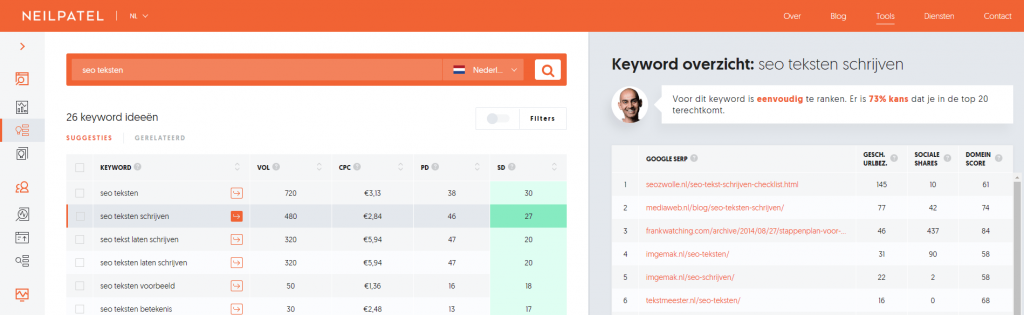
Image 1: Keyword research via Ubersuggest
1. Focus on the main keyword
Make sure that your text is as complete and specific as possible about this subject.
2. Extensive content
Make sure that your text is at least 400+ words or more. The longer someone spends time on your article, the lower the bounce rate (the percentage of visitors who leave your website without taking action). Google uses this to determine the value of an article. However, rather than focusing on as many words as possible, focus on providing as much value as possible.
3. Check out the competition
Take a look at competitors’ texts for your main keyword. If a competitor has an article with 5 tips on the subject, try to create an article yourself with 20 tips or, for example, recommendations from a recent study.
4. Main keyword in the H1 of your page
Make sure your main keyword is in the headline of the page and within the <H1>. Headers are there to structure your article. When your main keyword is in the H1 header, your reader immediately sees that the text is about that.
5. Main keyword in the first paragraph
Mention the main keyword in the first paragraph of your text so that it is immediately clear to Google what your text is about.
6. Main keyword in the last paragraph
Also mention the main keyword in the last paragraph of your text. The article is often summarized in the last paragraph so it is always mentioned. This way, the search engine sees that the entire text is about the topic and not just the first paragraph.
7. Use synonyms
Avoid overusing your main keyword in the text. Google also understands what your text is about when you use synonyms or other words related to the topic.
8. Multimedia usage
Make your text attractive to read by using images, videos or gifs. Nobody is happy with a chunk of text without variety, subheadings and bullet points. This is reflected in the average time that visitors spend reading your text.
9. Avoid duplicate content
Never just copy someone else’s text. Google punishes duplicate content (the same content as elsewhere on the web) harshly.
10. Up-to-date
Always keep your text up to date. Are there any new developments on your topic? Adjust your text accordingly. More up-to-date content ranks higher in Google than content that is outdated.
11. Added value
Make sure your text adds value to the texts that already exist for your keyword. Avoid a sales pitch within your text and make sure it is a neutral article on the specific topic.
12. Google Trends
Through Google Trends you can get insight into current search terms. Here you can see which keywords are trending at the moment (because of the news or because they are seasonal). So always check Google Trends to see if this is the ideal time to write something for your chosen keyword.
13. Internal links
Use internal links to other interesting content on your website.
14. External links
If relevant, also place external links to useful websites or articles. For example, if you want to support your content with research from another website.
Tips for the meta texts
The meta texts are visible within the <head> of your page as well as within the search results in Google. The meta text can be divided into the meta title and meta description.

Image 2: Example of a meta text of Leadgate Europe
Meta texts used to be the most important SEO factors but now they are especially important for increasing CTR from search results. Through the meta texts you explain to a potential visitor why he or she should read your content.
15. Include your keywords in the meta title en description
This will clearly show what your content is about. Place them at the beginning of the meta text.
16. Unique meta title and meta description
Make sure you use a unique meta title and meta description that do not appear elsewhere on your website.
17. Maximum meta title length of 65 characters and meta description of 160 characters
If it is longer, Google will truncate your meta title and meta description.
18. Core message in front
Put the gist of your article in the first few characters of your meta description.
19. Use the keyword once
Avoid the frequent use of your main keyword in the meta text, preferably only once in the meta title and once in the meta description.
20. Provide attractive meta texts
As mentioned, these serve mainly to increase the CTR from the search results. The higher the CTR, the better the ranking.
How does Leadgate help?
Do you need help writing SEO-optimized texts? Our content team is happy to help. Get in touch with us.